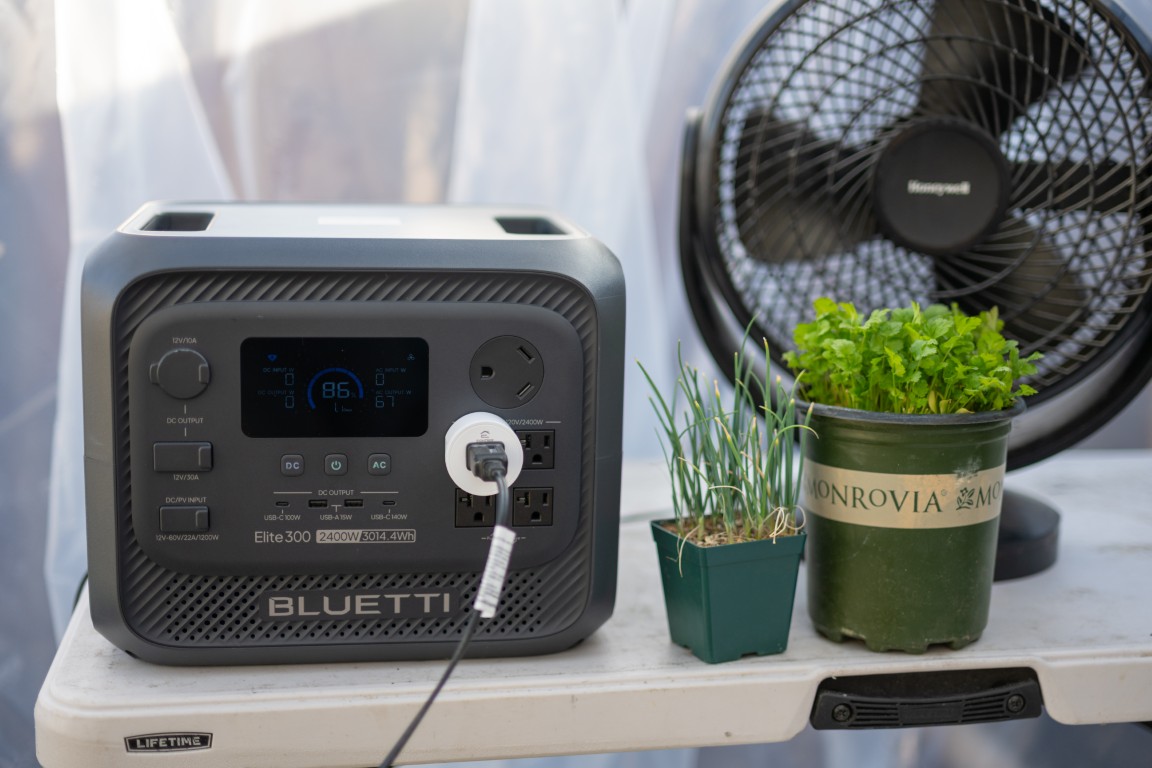
Bluetti has officially lifted the curtain on the Elite 300, a 3.1 kWh portable power station the company claims is the smallest of its capacity class yet produced. Boasting 2,400 W of continuous AC output, dual fast-charge capability and a lithium-iron-phosphate (LiFePO₄) pack rated for more than 6,000 cycles, the unit is being offered at a launch discount through the firm’s online storefront and select retail partners.
The release arrives at a moment when consumer demand for battery-based backup systems is surging amid increasingly frequent grid failures and prolonged extreme-weather events. Analysts at the U.S. Energy Information Administration recorded a 64-percent year-over-year spike in outage hours nationwide during 2023, a trend manufacturers say is steering discretionary spending toward self-reliant power solutions.
Measuring 385 × 298 × 336 mm and weighing 34 kg, the Elite 300 occupies roughly 30 percent less volume than Bluetti’s own AC300 plus B300 combination, yet matches the earlier rig in raw storage. The footprint reduction was achieved, executives said, by repackaging cylindrical LiFePO₄ cells into a denser array and integrating the battery management system (BMS) directly onto the mainboard rather than inside a discrete sled.
"We set out to prove that kilowatt-hours don’t have to scale linearly with size," Bluetti chief engineer Leo Gu told press during a virtual briefing. "By moving to a laminated bus-bar topology and liquid-phase thermal interface, we cut internal impedance 18 percent and gained headroom for passive cooling fins, eliminating the need for active fans below 1,200 W output."
The unit ships with 14 output ports: four 20-amp AC sockets, one NEMA TT-30R for recreational vehicles, four USB-A, two 100 W USB-C PD ports, two regulated 12 V/10 A barrel jacks and one 12 V/30 A aviation-style connector. A 30-amp Anderson port serves high-draw appliances, while the dual USB-C rails can fast-charge modern laptops or the latest smartphones that have migrated to the standard.
Re-charge times are quoted at 1.3 hours on 1,800 W AC or 2.1 hours with 1,200 W of solar input; simultaneous dual-feed yields an 80-percent state-of-charge in 45 minutes. The inverter accepts 150–500 V of photovoltaic swing, allowing up to six 200 W panels in series without an intermediate optimizer. A 10-ms switchover speed positions the Elite 300 as an uninterruptible power supply for sensitive medical or computing equipment.
Companion software, available for iOS, Android and via Web dashboard, supports over-the-air firmware updates, real-time telemetry logging and geofencing alerts. Users can chain up to four Elite 300 units for 12 kWh of aggregate capacity, although the company is reserving a forthcoming expansion battery, dubbed the B300-E, for customers seeking single-stack modularity.
Cycle life is guaranteed at 80-percent residual capacity after 6,000 complete charge-discharge cycles, a figure that exceeds the typical lifespan of consumer LiFePO₄ chemistry and translates to more than 16 years of daily use. Bluetti backs the device with a five-year comprehensive warranty extendable to seven years with product registration.
Early adopters can pre-order the Elite 300 for US$1,999, a US$400 reduction from the US$2,399 MSRP, through 11 August. The incentive mirrors an industry-wide push to secure market share as battery-cell prices rebound from 2024 lows. Bluetti executives indicated that volume production has already commenced at the firm’s facility in Shenzhen, with first shipments slated for late August in North America and early September for the EU and UK.
Competitive set includes Anker’s Solix F2000, EcoFlow’s Delta Pro and Zendure’s SuperBase V, all of which hover near the 3 kWh mark but occupy upwards of 0.13 m³. Bluetti’s claim of "smallest" rests on a volumetric comparison of commercially available, retail-ready power stations rated between 3.0 and 3.3 kWh as of 1 July, verified by third-party metrology lab SGS-CSTC Standards Technical Services.
Environmental bona fides are buttressed by a modular architecture that permits end-of-life separation of the aluminum chassis, lithium cells and power electronics. The firm has partnered with recycling specialist Redwood Materials to offer customers no-cost mail-back for depleted packs, a program first piloted with the company’s AC series.
Looking forward, Bluetti confirmed that the Elite line will serve as a platform for higher-density variants, including a semi-solid-state SKU slated for 2026 that could push energy density past 400 Wh/L while trimming another 15 percent from the form factor. Until then, the Elite 300 appears positioned to set a new spatial benchmark for off-grid, whole-home and professional field power—provided supply chains remain stable and lithium carbonate pricing stays within the current band.


0 Comments