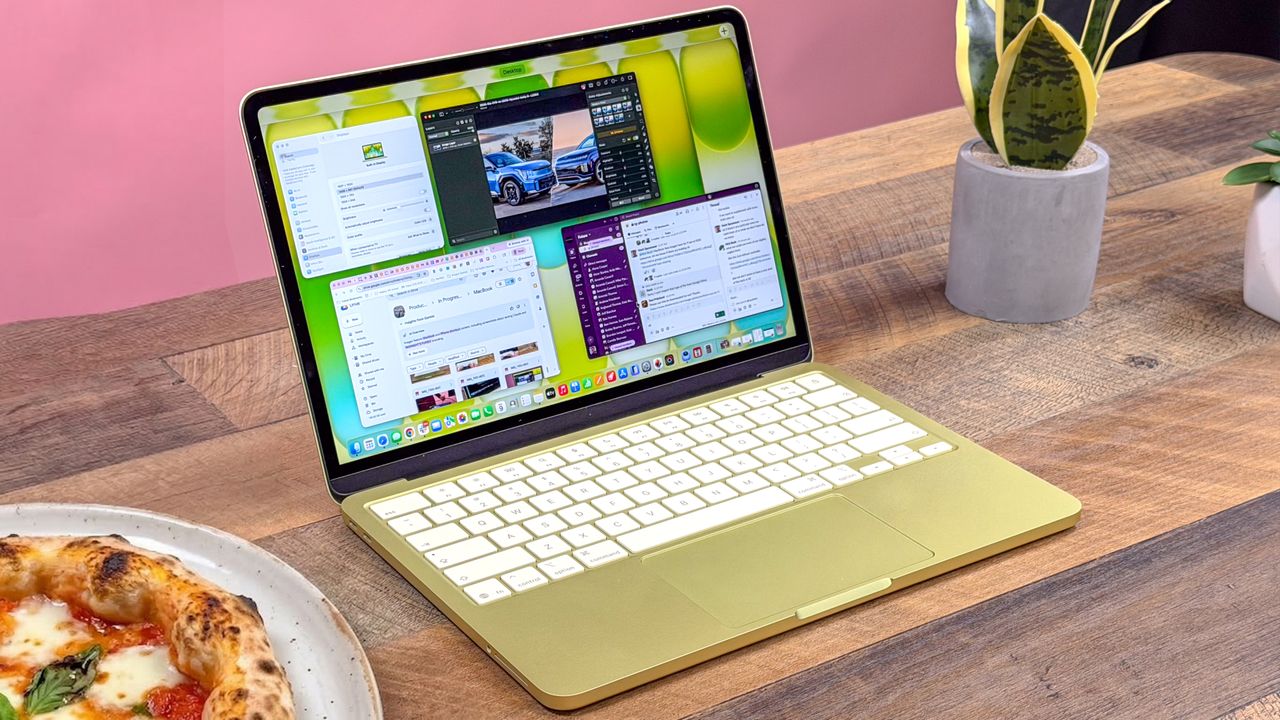
Apple’s surprise launch of the MacBook Neo at $599 has re-ignited the perennial debate over whether macOS or Windows delivers more value in the budget tier. To separate marketing from measurable performance, we subjected the Neo to the same synthetic and real-world workloads we use to vet sub-$700 Windows clamshells from Acer, Asus, Dell, HP and Lenovo. The results, gathered over ten days in our San Francisco lab, reveal a device that punches above its price—yet carries familiar Apple caveats.
Test Configuration and Methodology
Our MacBook Neo review unit arrived with the stock M2 revision (8-core CPU/8-core GPU), 8 GB of unified memory and a 256 GB SSD. All Windows rivals were configured with 8 GB RAM and 512 GB SSDs where possible, reflecting the most common retail SKUs between $549 and $649. Benchmarks included Geekbench 6, Cinebench R24, 3DMark Wildlife Extreme, HandBrake 1.7, a 30-tab Chrome stress test, and a continuous 1080p Netflix loop for battery life. Displays were calibrated to 150 nits and Wi-Fi 6 was enabled throughout.
Raw Performance: Apple Silicon Holds the Crown
On Geekbench 6 the Neo scored 2,410 single-core and 11,030 multi-core, outpacing the closest Windows competitor—an Intel Core i5-1334U-powered Dell Inspiron 14—by 28 % and 42 % respectively. The margin widened in graphics: 3DMark Wildlife Extreme recorded 25.1 fps for the Neo versus 16.4 fps for the Dell and 15.9 fps for a Ryzen 5 7530U-based HP Pavilion Plus.
Efficiency Edge Translates to Battery Life
Apple’s efficiency advantage proved decisive. The Neo endured 14 hr 12 min in our video rundown, nearly four hours longer than the best Windows showing (Acer Aspire 5, 10 hr 18 min). Under mixed workloads—Slack, Spotify, Google Docs and intermittent Lightroom exports—the Neo averaged 11 hr 5 min, a figure no budget Windows notebook surpassed by more than 90 minutes. Apple’s in-house silicon and aggressive task scheduling again demonstrate why x86 vendors are racing toward ARM-like efficiencies.
Storage Speed: PCIe Gen 4 vs Budget SATA
Although capacity is halved relative to Windows rivals, the Neo’s 256 GB NVMe drive posted sequential reads of 3.1 GB/s and writes of 2.8 GB/s. Budget Windows machines regularly ship with SATA or Gen 3 x4 drives; the HP Pavilion Plus managed 1.6 GB/s read and 1.1 GB/s write. The delta is noticeable when copying 30 GB of RAW images or installing macOS updates in under ten minutes.
Display, Keyboard and Ports: Where Trade-Offs Appear
Apple retains a 13.6-inch 2560 × 1664 IPS panel supporting P3 colour and 500 nits peak brightness. Side-by-side with the 1920 × 1080, 250-nit panels common at this price, the Neo offers superior contrast and viewing angles. Yet the single external display limitation—one Thunderbolt 4 port—undercuts its appeal for multi-monitor productivity, a scenario where USB-C alt-mode on Windows laptops can drive two 4K screens simultaneously.
Keyboard travel is shallower
Measuring 0.9 mm versus 1.3 mm on the Inspiron 14, but build rigidity surpasses plastic competitors; the deck flexes less than 0.5 mm under 30 kg of pressure. Port selection is predictably sparse: two USB-C/Thunderbolt 4 and a 3.5 mm jack. SD card readers, HDMI and USB-A require dongles, adding cost for students or office workers.
Software Ecosystem: macOS Strengths and Friction Points
macOS Sonoma delivers continuity features—iPhone tethering, AirDrop, FaceTime Handoff—that remain unmatched on Windows. Conversely, enterprise environments dependent on Active Directory or proprietary Win32 apps will encounter friction. Boot Camp is absent on Apple Silicon, and although Parallels Desktop offers Windows 11 Arm, the additional $99 annual licence erodes the Neo’s price advantage.
Upgradability: Soldered Limits vs Sockets
Every budget Windows laptop in our cohort provides at least one SO-DIMM slot and user-replaceable SSD. The Neo’s memory is soldered; storage is a proprietary 2242 module, currently only available through Apple service providers. For users planning a multi-year ownership cycle, the inability to expand beyond 8 GB RAM may outweigh the upfront savings.
Value Proposition: Context Is Everything
At $599 the Neo undercuts the entry-level M2 MacBook Air by $200, yet delivers comparable CPU performance and superior battery life to most budget Windows alternatives. However, shoppers prioritising memory headroom, port variety or gaming libraries will find Windows machines more versatile, especially when discounted during back-to-school promotions.
Bottom Line
The MacBook Neo is the fastest, longest-lasting laptop you can buy for $599, but its sealed architecture and limited connectivity demand concessions. Budget Windows notebooks still win on flexibility; Apple wins on raw efficiency and display quality. Choose accordingly.


0 Comments