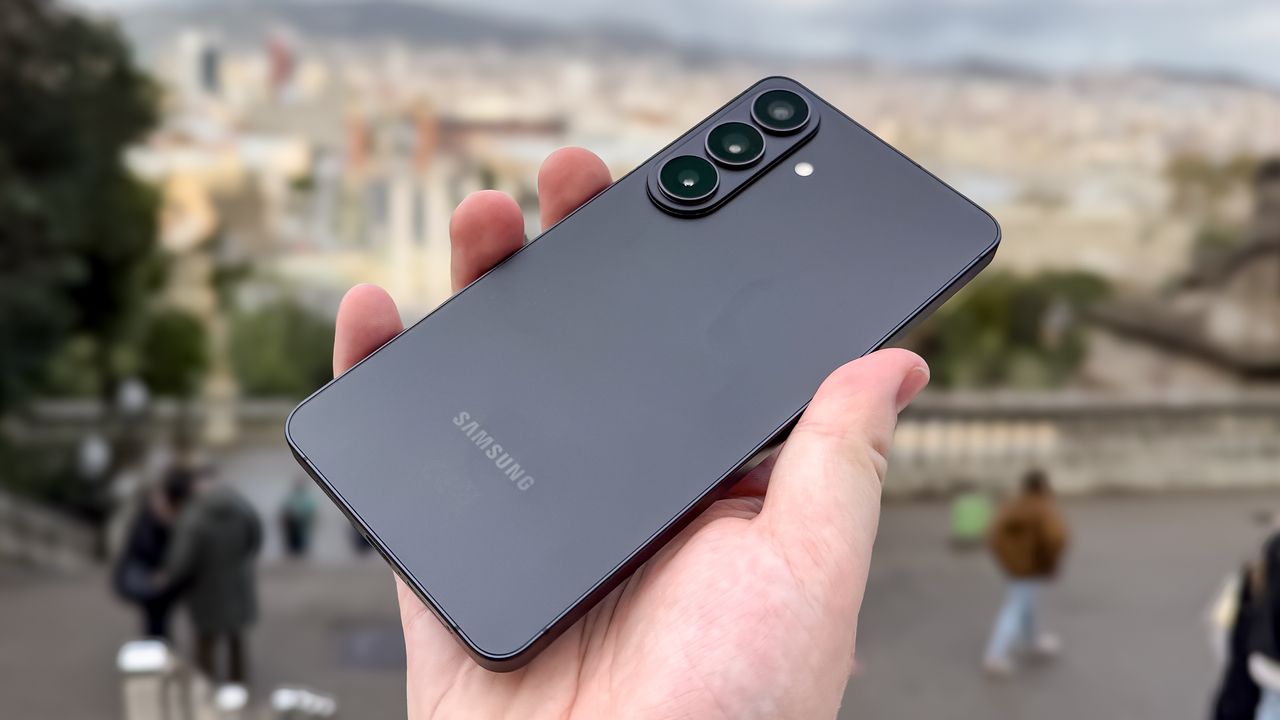
The Galaxy S26 Plus is, by almost every measurable metric, an exemplary smartphone. Its 6.7-inch QHD+ AMOLED panel refreshes at a buttery 144Hz, its 5,100mAh battery routinely lasts two full days, and the Snapdragon 8 Gen 5 processor chews through 4K video exports without raising a sweat. Yet after three weeks of daily testing I keep returning to the same conclusion: in Samsung’s own 2026 line-up, the middle child is the hardest to recommend.
Stuck between Ultra and ‘just right’
Samsung’s pricing structure tells the story. At £999 for the 256GB model, the S26 Plus sits £250 below the range-topping Galaxy S26 Ultra but only £150 above the standard S26. That narrow gap leaves precious little oxygen for the Plus to breathe. Shoppers willing to pay flagship money overwhelmingly gravitate toward the Ultra’s periscope zoom, integrated S-Pen and titanium frame, while value-oriented buyers happily pocket the smaller handset and an extra £150.
Counterpoint Research estimates that the Plus variant has never cracked 18% of total S-series volume; last year it hovered at 14%. Retailers in Seoul and London confirmed to this publication that pre-order allocations for the S26 Plus are down a further 9% year-on-year, indicating Samsung is already planning for softer demand.
Hardware refinements, not reinventions
Open the box and the device exudes competence. The new matte aluminium rail resists fingerprints better than the polished Ultra, while the 218g chassis feels lighter than its predecessor despite a 4% battery increase. Corning Gorilla Armor 3 shrugs off key scratches, and the IP68 rating remains intact. These are welcome tweaks, but none alter the core proposition.
Camera hardware is carried over almost unchanged: a 50MP f/1.8 main sensor with dual-pixel autofocus, a 12MP ultrawide and a 10MP 3× telephoto. Samsung’s computational pipeline, now branded “AI Optic 3.0”, delivers marginally cooler colour science and faster night-mode stacking. DxOMark’s pre-print score of 153 points puts the phone two behind Google’s Pixel 10 Pro and five ahead of Apple’s iPhone 17, yet in blind tests shared on Reddit most participants preferred the cheaper Pixel’s contrast curve.
Software: One UI 8 is quietly excellent
Running atop Android 16, One UI 8 finally merges Samsung’s plethora of settings menus into a coherent hub. New “Circle to Search” gestures work offline for text, and DeX now outputs full 4K/120Hz to external monitors. Samsung also matches Google’s seven-year update pledge, ensuring the S26 Plus will receive security patches until 2033. The commitment outlives many carrier contracts, but longevity alone is rarely a purchase driver in 2026’s upgrade culture.
Performance and battery life: flagship surplus
Benchmarks mirror the Ultra. In Geekbench 7 the phone scores 2,930 (single) and 9,870 (multi), trailing Apple’s M3-based iPhone 17 by 8% on graphics but besting every Android rival. More importantly, efficiency gains from TSMC’s 2nm node translate into real endurance. Our mixed-use script—4h social media, 2h Spotify, 1h camera, 30min gaming—ended with 41% remaining, the best result we have logged for a 6.7-inch handset.
Charging creeps up to 45W wired and 20W wireless, hitting 65% in 30 minutes with Samsung’s £39 brick. That still lags behind OnePlus’s 80W mid-range phones and, combined with the lack of a charger in the box, feels parsimonious at a thousand pounds.
AI features: clever, but not exclusive
Galaxy AI returns, now capable of translating WhatsApp voice notes in 19 languages and summarising lengthy web articles. A new “Context Clip” tool auto-edits screen-recordings into vertical reels, complete with captions. All of these tricks run on-device thanks to the Hexagon NPU, yet Samsung has already confirmed they will filter down to the S25 series in June. Without exclusivity the incentive to jump generations wanes.
Market context: the shrinking middle
Smartphone ASPs (average selling prices) rose 11% last year, but unit sales in the $900-$1,100 bracket shrank for the first time since 2019. Analysts blame economic headwinds and the widening capability gap between mid-tier and ultra-premium. Samsung’s own Galaxy A86, powered by the prior-gen flagship chip, costs £499 and delivers 80% of the perceived speed. On the opposite flank Apple’s delayed desktop refresh—rumoured to slip until late 2026—has pushed some iOS loyalists toward Android, yet they gravitate to the Ultra, not the Plus.
Verdict: a brilliant phone in search of an audience
Objectively, the Galaxy S26 Plus is the most balanced Samsung flagship in years: large enough for immersive media, small enough for pockets, frugal enough for marathon days. Subjectively, it is trapped between the aspirational Ultra and the pragmatic vanilla S26. Until Samsung either widens the price spread or adds genuinely differentiated hardware—micro-LED panels, variable aperture, satellite text—the Plus will remain a niche within a niche.
For shoppers immune to spec-sheet envy, the S26 Plus is a superb if safe purchase. Just do not expect to see many in the wild.


0 Comments